In many Western cultures, names are chosen based on family tradition, aesthetic appeal, or phonetic rhythm. In traditional Chinese culture, however, a name is viewed as a lifelong blueprint for harmony—a dynamic tool designed to interact with the exact energetic blueprint of the moment you were born.
This cosmic calculation relies on BaZi (八字), or the Four Pillars of Destiny, an ancient astrological system that decodes your personal energy matrix to craft a name that acts as a lifelong energetic anchor.
Key Takeaways
- Cosmic DNA: BaZi maps your birth year, month, day, and hour into four pairs of distinct characters (eight characters total), acting as an energetic snapshot of the universe at your birth.
- The Five Elements: Every character in your chart is linked to one of the Wuxing (Wood, Fire, Earth, Metal, or Water).
- Naming for Balance: BaZi naming isn’t just about choosing beautiful words; it’s about strategically introducing specific characters to achieve balancing BaZi elements that are missing or weak in your chart.
What is BaZi?
Your BaZi chart functions like a spiritual snapshot of the sky at the exact time of your birth. The term “BaZi” literally translates to “Eight Characters.” These characters are derived from four pillars: your birth year, month, day, and hour. Each pillar consists of one Heavenly Stem and one Earthly Branch.
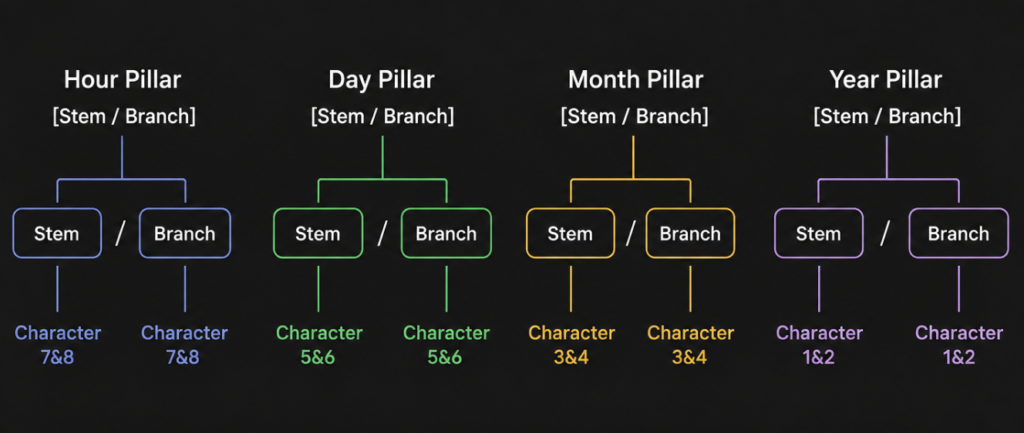
Crucial Astrological Distinction: For true cosmological calculations, the astrological year transitions at Lìchūn (立春)—the solar term marking the start of spring in early February—rather than the highly publicized Lunar New Year’s Day.
To explore the precise mathematics and historical framework behind this system, you can read up on the intricate history of the Four Pillars of Destiny calculations.
The Core of BaZi Naming: The Day Master and the “Useful God”
A common misconception is that if you lack a specific element in your BaZi chart, you must automatically add it to your name. This is false and can sometimes do more harm than good.
In professional BaZi naming, the entire chart revolves around the Day Master (日主), which is the Heavenly Stem of your birth day. The Day Master represents your core self. The naming master’s goal is to evaluate whether your Day Master is structurally Strong or Weak based on the season you were born in and the supporting elements around it.
- The Useful God (用神 – Yòng Shén): This is the single most critical element your chart needs to achieve equilibrium. If your Day Master is a weak Fire element, your “Useful God” is likely Wood (to fuel it) or more Fire (to reinforce it). Your name should explicitly introduce the Useful God, not just any missing element.
- The Annoying God (忌神 – Jì Shén): This is the element that disrupts your chart. If your Fire Day Master is already overwhelmingly hot and dry, adding a Fire-radical name would be like throwing kerosene on a bonfire, leading to emotional volatility or obstacles.
The Role of the Five Elements (Wuxing)
According to Chinese cosmology, optimal health, emotional resilience, and prosperity flow from a state of dynamic equilibrium among the Five Elements: Wood (木), Fire (火), Earth (土), Metal (金), and Water (水).
The primary goal of a master naming strategist is to identify your Day Master and see what elements it needs for support or mitigation.
| Target Element | Associated Traits & Virtues | Visual Radicals | Example Characters for Balancing BaZi Elements |
| Water (水) | Wisdom, fluidity, intuition, adaptation | 氵, 水, 冫 | 涵 (Hán – to contain/cherish), 泽 (Zé – pool of brilliance) |
| Wood (木) | Growth, vitality, benevolence, flexibility | 木, 艹, 竹 | 芳 (Fāng – fragrance/blossom), 霖 (Lín – timely rain abundant for growth) |
| Fire (火) | Passion, propriety, energy, radiance | 灬, 火, 日 | 曦 (Xī – dawn light), 朗 (Lǎng – clear, vital, bright) |
| Earth (土) | Trust, stability, patience, grounding | 土, 山, 石 | 宇 (Yǔ – space/universe, grounding), 磊 (Lěi – pile of stones, solid) |
| Metal (金) | Righteousness, focus, strength, clarity | 金, 钅, 刂 | 铭 (Míng – engraved motto/talent), 睿 (Ruì – sharp, astute wisdom) |
Restoring Balance Through Character Structure
When a birth chart lacks an element, naming experts don’t just pick a word that means “water” or “fire.” They look at the physical anatomy of the Chinese character. This is where five elements chinese name creation becomes a fine art.
1. Radical Infusion (The Physical Component)
Chinese characters are built using components called radicals. If your chart requires the element of Metal, a naming master will often select characters containing the metal radical (钅 or 金). For instance, the character Jùn (镌 – to engrave) physically embeds the metal element directly into the visual and written structure of the name.
2. Intrinsic Meaning & Sound Energy
Beyond the physical brushstrokes, the intrinsic meaning and the phonetic vibration of the character carry elemental weight. A name is spoken aloud thousands of times over a lifetime. The sound frequency of a well-chosen character acts as a subtle, repetitive remedy to realign your personal energy field. By anchoring your name to your birth chart, you are selecting a name meant to optimize your natural constitution.
3. Stroke Count Harmony (Sancai Wuge)
In advanced naming architectures, experts also calculate the Sancai Wuge (三才五格) mathematical system. This system counts the literal brushstrokes of the family surname combined with the given names to ensure the mathematical interactions between the “Heaven, Earth, and Human” sectors yield auspicious, harmonious numbers.
Conclusion
Integrating your birth date into your name turns a simple linguistic label into an artful balancing act. It harmonizes your identity with the elements of the natural world. Curious to see what elements your birth chart calls for? Head over to our interactive tool to Get my name and see your custom chart configuration.
FAQs
Does the Chinese Zodiac animal affect my name?
Yes, but it is secondary to the overall BaZi chart. The zodiac animal is tied strictly to your birth-year Earthly Branch. While some folklore suggests picking characters or radicals that suit your specific animal (for instance, using grass 艹 or water 氵 radicals for a Goat or Ox), this serves more as a colorful, auspicious addition to your name’s narrative rather than a strict metaphysical requirement. The entire eight-character chart always takes precedence.
How do I find out which element I am missing or need?
You need an analysis of your birth year, month, day, and exact hour. You can see how we process these coordinates by visiting our How it works framework.
What happens if my name has the wrong elements?
In Chinese metaphysics, a name acts as a repetitive mantra. If a chart is already heavily dominant in Fire, and the name adds more Fire radicals, it is believed to amplify negative traits associated with an excess of that element—such as impatience, poor physical health (particularly cardiovascular or inflammation issues), or sudden conflict in career and relationships. Correcting the name is thought to smoothen life’s obstacles.
Can an adult change their name to fix their BaZi balance?
Absolutely. Many adults choose a professional Chinese “style name” (号 – Hào) or legally change their given names later in life if they feel their original name is working against their astrological chart. Even if you do not legally change your name on official government documents, simply having friends, family, or colleagues address you by your new balanced name aloud can shift the energetic vibration around you.
Can I just use a name with all five elements to be safe?
This is a common trap. Trying to balance a name by packing all five elements across different characters usually dilutes the effectiveness of the specific element you actually need. Furthermore, a Chinese given name typically consists of only one or two characters—meaning you physically do not have enough real estate to include every single element radical cleanly without creating a chaotic, unpronounceable name. Focus entirely on your “Useful God.”