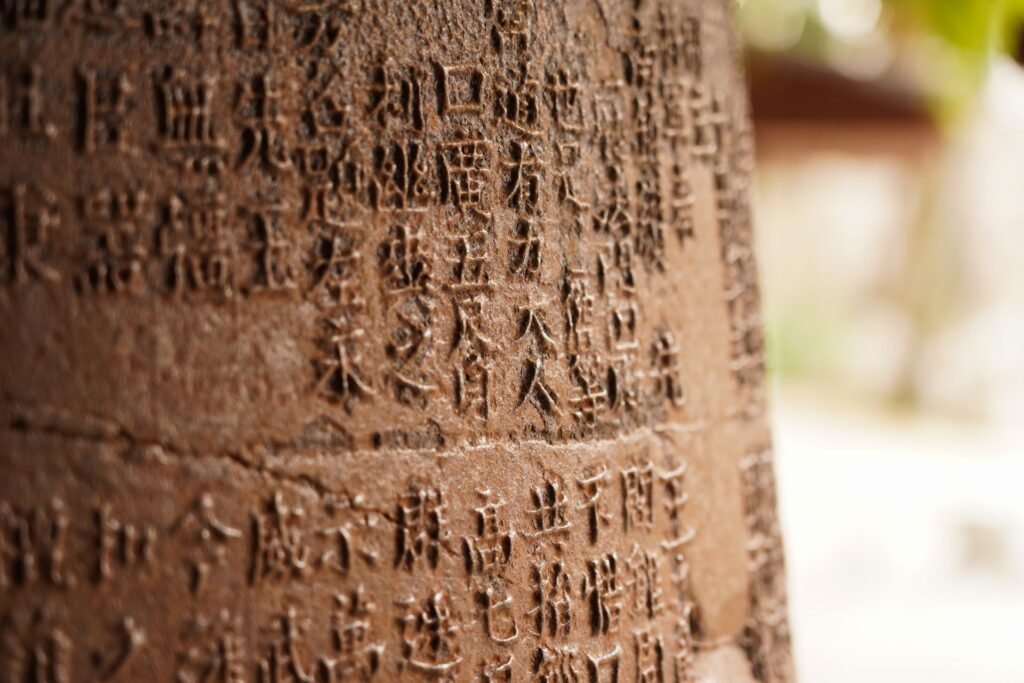
A Chinese given name gets composed fresh for each person. A surname works completely differently. It’s inherited, not chosen. It also comes from a surprisingly small pool. Fewer than a few hundred surnames cover most of China’s population. Here’s what common Chinese surnames actually mean, where they came from, and how they fit into a full name.
Key Takeaways
- Chinese surnames come first in a full name, ahead of the given name, and they’re passed down rather than composed.
- A relatively small set of surnames covers most of the population. Names like 王 (Wáng) and 李 (Lǐ) are shared by tens of millions of people.
- Surnames trace back to a few common origins: ancient states, ancestral titles, occupations, and place names.
- Most surnames are a single character, but two-character “compound” surnames exist too, like 欧阳 (Ōuyáng).
- Surnames carry no gender in Chinese, unlike given names, which often do lean feminine or masculine.
- If you’re building a full name, Chinese Name Studio’s generator matches a surname to your own name’s sound automatically.
What Chinese Surnames Actually Are
A surname (姓, xìng) sits at the front of a Chinese name, before the given name. That’s the reverse of English order, where a family name comes last. If you want the given-name side of this story, our Chinese First Names guide covers that half in depth.
Surnames and given names work nothing alike. A given name gets composed fresh for each person, often combining two characters for a layered meaning. A surname is fixed. You inherit it, and you don’t get to invent a new one. That’s also why the pool is so much smaller. A few hundred surnames account for most of the population. Given-name combinations, by contrast, number in the millions.
Where Chinese Surnames Come From
Most Chinese surnames trace back to one of a few sources. Some come from ancient states or fiefdoms. 陈 (Chén), 赵 (Zhào), and 吴 (Wú) all started as place names before becoming family names. Others come from ancestral titles or occupations. 司马 (Sīmǎ), for example, literally means “manage horse.” That was an ancient military title, later passed down as a surname.
A few surnames come from legend rather than geography. 张 (Zhāng) traces back to a mythical ancestor credited with inventing the bow and arrow. Others simply describe something concrete. 马 (Mǎ) means “horse.” 林 (Lín) means “forest.” Want a deeper, well-sourced rundown of these patterns? Wikipedia’s page on the Hundred Family Surnames covers the classical text that first catalogued many of them.
Common Chinese Surnames and Their Meanings
Here’s a real, commonly used set of Chinese surnames, along with what each one means and where it came from:
| Character (Pinyin) | Meaning | Origin |
| 王 (Wáng) | King, ruler | Denoted royal or noble descent |
| 李 (Lǐ) | Plum | Tied to a plum-tree legend and the Tang imperial family |
| 张 (Zhāng) | To draw a bow | From a legendary ancestor said to have invented the bow |
| 刘 (Liú) | Archaic; no common modern meaning | Carried by the Han dynasty’s founding imperial family |
| 陈 (Chén) | To state, lay out | From the ancient State of Chen |
| 杨 (Yáng) | Poplar tree | Possibly from a place name near poplar groves |
| 黄 (Huáng) | Yellow | Linked to the ancient State of Huang |
| 赵 (Zhào) | A proper name only | From the ancient State of Zhao |
| 吴 (Wú) | A proper name only | From the ancient State of Wu |
| 周 (Zhōu) | Cycle, complete | From the Zhou dynasty |
| 孙 (Sūn) | Grandson, descendant | Originally an honorific for a family’s descendants |
| 马 (Mǎ) | Horse | A common Han surname, and also a Hui Muslim name from “Muhammad” |
| 林 (Lín) | Forest, grove | From a place name or natural feature |
王 (Wáng) and 李 (Lǐ) consistently rank among the most common surnames in mainland China. Each one is shared by tens of millions of people. For a fuller, regularly updated ranking, Wikipedia’s list of common Chinese surnames tracks population data by source and region.
Two-Character Surnames
Most Chinese surnames are a single character, but compound surnames exist too. They’re rarer, making up only a small slice of the population. Even so, they carry real history.
- 欧阳 (Ōuyáng) — This name comes from a place near Mount Yang, in what’s now Zhejiang province.
- 司马 (Sīmǎ) — This one started as an official title for a minister of war. It later passed down as a hereditary surname, most famously borne by the historian Sima Qian.
These compound surnames pair with given names the same way single-character ones do. The only real difference is length. A compound surname plus a given name often produces a four-character full name, instead of the usual three.
How a Surname Pairs With a Given Name
A surname is only half a full Chinese name. The given name is what actually carries most of the personal meaning. Grace, strength, wisdom — whatever quality someone wants, that’s where it goes. Curious how that half gets chosen? Our guides for Chinese names for men and Chinese names for women break down the common themes for each.
One clarification worth making here: your birth chart, if you choose to use one, only affects the given name. The traditional BaZi (八字) system reads your birth date. It then points to an element worth reinforcing, but it never touches which surname you’d use. Our guide to BaZi and how your birth chart shapes your Chinese name has the full picture.
If You Don’t Have a Chinese Surname Yet
Plenty of people building a Chinese name for the first time don’t have a surname to start from. That’s normal, and it’s not something you need to research alone. The common approach is simple. Pick a surname whose sound echoes the start of your own name, then build a given name around it.
Chinese Name Studio’s generator does exactly this. It matches a real surname to your name’s sound. Then it builds a given name from the qualities and birth chart you provide. Want the fuller picture of how the whole process works? Our general guide to Chinese name generators covers it in more depth. Our guide on how to choose a Chinese name walks through the decision process beyond just the surname.
Wrapping Up
A Chinese surname isn’t something you compose. It’s something you inherit — drawn from a small, ancient pool of names tied to old states, titles, and legends. Common ones like 王, 李, and 张 carry centuries of history in a single character. Once you’ve got a surname that fits, the given name is where the rest of the meaning comes in. Chinese Name Studio’s generator can build both halves for you in one pass.
Frequently Asked Questions
What do Chinese surnames actually mean?
Many carry a literal meaning tied to their origin. 马 (Mǎ) means “horse.” 林 (Lín) means “forest.” 黄 (Huáng) means “yellow.” Others, like 陈 (Chén) or 赵 (Zhào), trace back to ancient state names rather than an everyday word. They function more like proper nouns than translatable terms. A surname’s meaning usually says more about a family’s distant past than about the person carrying it today. That’s a real contrast with given names, which get chosen specifically for what they express about an individual.
What are the most common Chinese surnames?
王 (Wáng) and 李 (Lǐ) are consistently among the most common surnames in mainland China. Each is shared by tens of millions of people. Others like 张 (Zhāng), 刘 (Liú), 陈 (Chén), and 杨 (Yáng) also rank near the top of most population surveys. Together, a relatively small number of surnames account for a large share of the population. That’s part of why Chinese naming puts so much weight on the given name. It’s what actually distinguishes one person from another. Rankings do shift slightly between surveys and regions, so treat any single ordered list as an estimate.
Where do Chinese surnames come from?
Most trace back to one of a few sources. Some, like 陈, 赵, and 吴, come from the names of ancient states or fiefdoms. Others come from ancestral titles or occupations, the way 司马 originally meant “manage horse,” an old military post. A few come from legend, like 张’s ties to a mythical bow-inventing ancestor. Still others simply describe something concrete, such as 马 (“horse”) or 林 (“forest”). The variety reflects thousands of years of history, compressed into a single character.
Are there Chinese surnames with two characters?
Yes, though they’re much less common than single-character ones. 欧阳 (Ōuyáng) and 司马 (Sīmǎ) are two well-known examples. Each traces back to a specific place or title, rather than an ordinary word. Compound surnames work the same way as single-character ones, once paired with a given name. The person still has a surname followed by a given name — just with one extra character up front. A compound surname plus a two-character given name typically produces a four-character full name. That’s one more than the more common three-character pattern.
Can I choose my own Chinese surname if I’m not Chinese?
Yes, and it’s the standard approach for anyone building a Chinese name from scratch. Surnames aren’t tied to ethnicity or nationality. So the usual method is to pick one whose sound echoes your own name. There’s no need to search for a “correct” surname based on heritage. A generator can do this matching for you automatically. Or you can compare a few options against your own name’s sound yourself. Either way, the given name that follows is where you’ll add most of the personal meaning.
Do Chinese surnames differ between men and women?
No. Chinese surnames carry no gender at all. The same surname, such as 王 (Wáng) or 李 (Lǐ), belongs to men and women alike within the same family. No separate “male” or “female” version exists. This is different from given names. Given names often do lean feminine or masculine, based on the characters chosen, even though Chinese itself has no grammatical gender. If you’re building a name for yourself, the surname choice stays the same. That’s true no matter which voice you pick for the given name.
How many Chinese surnames are there in total?
Historical records list several thousand surnames that have existed at some point. The number in common use today is far smaller. A few hundred surnames cover the vast majority of the population. A handful of those, like 王 and 李, are shared by tens of millions of people each. This concentration is part of why given names carry so much personal meaning in Chinese naming. With a relatively small surname pool, the given name is what makes a full name feel individual.
How does a surname pair with a given name in a full Chinese name?
The surname comes first. A one- or two-character given name follows, producing the classic three- or four-character full name pattern. The pairing matters for how the name sounds as a whole. A given name that flows naturally after one surname can feel clumsy after another. Beyond sound, the surname itself carries no chosen meaning for the individual — that’s the given name’s job. The simplest check is to say a few options aloud, right after your surname. If it flows, the full name works.